2 hr
Basel Old Town Walking Tour
Discover the heart of Switzerland's cultural capital on a 2-hour guided stroll through centuries of history.
Reserve
Hand-picked by our editors — only the best 5 walking experiences from 12 reviewed.
Verified partners for every tour, free cancellation where available, and instant confirmation on every booking.
2 hr
Discover the heart of Switzerland's cultural capital on a 2-hour guided stroll through centuries of history.
Reserve
2 hr
Discover Basel's medieval quarter and Gothic landmarks with a local expert on this personalized walk
Reserve
1 hr
Compact one-hour guided walk through Basel's historic center, architecture, and fountains
ReservePrices from verified partners. Availability updates in real time at checkout. Free cancellation policies apply where shown.
The landmarks, rooms, and views travelers on this tour remember — all visible on a single visit.
A whimsical kinetic sculpture featuring mechanical figures that move in water.
An 800-year-old cathedral featuring distinctive red sandstone and colorful roof tiles.
A vibrant 500-year-old painted town hall located at the historic Marktplatz.
One of the three remaining medieval city gates, serving as a historic defensive structure.
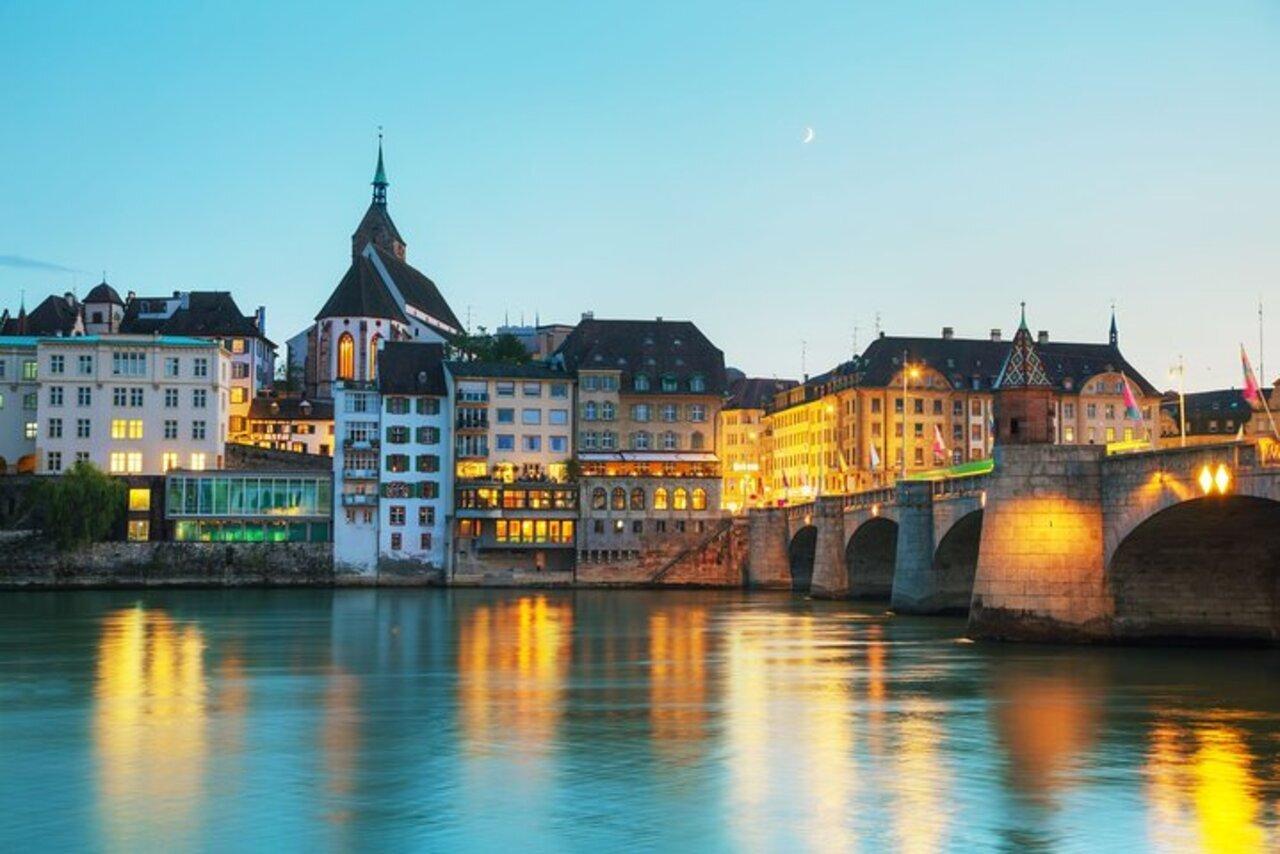
A historic bridge offering expansive views of the Rhine and the city skyline.
They complement each other, but most visitors who do both call the river cruise the more relaxing way to experience the city skyline after a basel public walking tour. Engaging in these basel public walking tour tours allows you to dive deep into the medieval Old Town architecture while the water-based perspective offers a tranquil look at the city's iconic bridges.
| Feature | Top pick Walking Tour | Rhine Cruise |
|---|---|---|
Perspective |
Street-level intimacy | Panoramic water views |
Physical Effort |
High; constant walking | Minimal; seated leisure |
Depth of Historical Context |
Extensive architectural detail | General historical overview |
Interaction with Locals |
Frequent; guides and residents | Limited to crew and passengers |
Optimal Weather Conditions |
Clear skies; dry pavement | Calm winds; clear visibility |
Best Time of Day |
09:00–17:00 | Daylight or golden hour |
| See tickets → |
Verdict: Choose the basel public walking tour tour for an educational deep-dive into Basel history, or opt for the cruise when you need to rest your feet while still securing basel public walking tour tickets for a complete city overview.
Choose your ticket, select your date, and reserve in under two minutes. Secure checkout handled by our verified partner.
Instant confirmation by email, with a mobile voucher you can save offline. No printing, no queuing at a collection desk.
Arrive at the entrance, show your voucher on your phone, and walk in. Most tickets include priority or skip-the-line access.
Practical details for your visit straight from our verified partners — hours, access, rules, and how to get there.
Comfortable walking shoes are essential for the cobblestone streets of the Old Town. Dress in layers suitable for changing weather along the Rhine.
Keep belongings secure in a compact day bag. If swimming in the Rhine, a Wicklefisch dry-bag is the local standard for protecting valuables.
Photography is encouraged throughout the basel public walking tour. Please respect the privacy of residents in the historic residential quarters.
Most of the Old Town is accessible to pedestrians, though steep inclines exist near Münsterhügel. Some historic buildings may have limited wheelchair access.
Children are welcome on the basel public walking tour. The route includes interactive public art and fountains that often engage younger visitors.
Numerous cafes and bakeries line the route, offering traditional treats like Basler Leckerli. Water fountains with potable water are found throughout the city.
Best time to go, insider tips, nearby landmarks, and the cancellation fine print — flip through to skim what matters to you.
Flexible, no hidden fees.
Self-guided basel public walking tour options are always available. For organized group bookings, please refer to the specific operator's terms, as some offer free cancellation up to 24 hours prior.
The Mittlere Brücke has spanned the Rhine since 1226, making it one of Europe's oldest river crossings still bearing daily foot traffic. Basel's compact Altstadt unfolds along both banks, a medieval grid where guild houses lean shoulder-to-shoulder and cobblestone alleys open onto sun-trapped plazas. The city grew rich on paper mills and merchant banks, and that mercantile restraint shows in the architecture: no Baroque excess, just red sandstone facades, clock towers with astronomical dials, and wrought-iron signs hung perpendicular to the street. Today Basel wears its 2,000-year legacy lightly. The Rathaus glows terracotta in morning light, its frescoed courtyard open to anyone willing to climb the stone steps from Marktplatz. Across the river, Grossbasel's cathedral district commands the high ground, its twin spires visible from the Wettsteinbrücke and the Rheinsprung staircase. Below, the Kleinbasel bank hums with cafes and galleries, the ferry landings busy from April through October. Walking remains the simplest way to parse the city's layered identity: Roman garrison, medieval trade hub, Reformation stronghold, contemporary art capital. The Basel public walking tour tradition rests on two principles: access and rhythm. Most scheduled group tours depart daily between 09:00 and 17:00, converging on Theaterplatz before threading through Freie Strasse, pausing at the Tinguely Fountain, then ascending to Münsterplatz. Guides work in German, English, and French, adapting commentary to the group's pace. The route rarely exceeds three kilometers, but the density of landmarks—Spalentor, the University's Renaissance courtyard, the painted facades along Rheinsprung—keeps the tempo measured. Self-guided variants follow the same spine, marked by brass plaques and QR-coded interpretive panels installed in 2022. What distinguishes Basel's walking culture is its refusal of spectacle. There are no costumed actors, no scripted anecdotes about phantom monks. Instead, you get sandstone provenance, guild politics, the mechanics of the Rhine's seasonal floods. The tours end where they began, at Theaterplatz, within sight of the tram lines that can carry you onward to Fondation Beyeler or the Vitra Campus. The city's walkability is not a feature engineered for tourism; it is the inherited geometry of a place that never sprawled, never demolished its ramparts in haste, and never prioritized cars over footpaths.

"The city's walkability is not a feature engineered for tourism; it is the inherited geometry of a place that never sprawled."
A step-by-step walkthrough of the visit — what you'll see, how long each stage takes, and the details that matter.
You meet your group at Theaterplatz, where the tram bells and the Tinguely Fountain's mechanical clatter set the morning's tempo. Your guide gestures toward the Freie Strasse, and you follow the group into the pedestrian corridor, past storefronts tucked beneath guild-house arcades. Within five minutes you reach Marktplatz, the Rathaus rising on your left, its painted facade a patchwork of civic allegory and heraldic crests. You pause to photograph the clock tower, then continue uphill along Rheinsprung, the lane narrowing as it climbs toward the cathedral plateau. At Münsterplatz you step into open air, the twin spires framing the Rhine valley below. The guide points out the crypt entrance and the cloister's Gothic tracery, but you drift toward the terrace wall, where the river bends south and the Wettsteinbrücke spans the current in three low arches. A ten-minute descent brings you back to riverbank level, crossing the Mittlere Brücke on foot. You stop mid-span to watch a ferry chug upstream, its green hull cutting through the slate-gray water. The tour loops back through Kleinbasel, skirting the university district and the narrow lanes behind Claraplatz. Your guide flags the Spalentor, its twin turrets straddling the old city gate, then circles you back to Theaterplatz. The entire circuit takes two hours, covers three kilometers, and delivers a clear mental map of Basel's core—enough to navigate the rest of your stay without consulting your phone.
The base price for self-guided or tip-based basel public walking tour experiences is 0 CHF.
Most guided versions of the basel public walking tour meet at the Tinguely Fountain, Theaterplatz, 4051 Basel.
The area is accessible 00:00–23:59, though the best arrival window is 09:00–17:00 for optimal daylight.
No formal basel public walking tour tickets are required for the self-guided routes; just arrive and explore.
We recommend the 09:00–17:00 window to ensure all historical landmarks are well-lit and accessible.
Yes, the basel public walking tour is family-friendly and includes engaging landmarks like the Tinguely Fountain.
Photography is perfectly fine during your basel public walking tour.
The Old Town is largely pedestrian-friendly, but visitors should be aware of some inclines and cobblestones during the basel public walking tour.
You can reach the Theaterplatz starting point easily via local tram lines that serve the city center.